Influencer marketing in India crossed a critical compliance threshold in 2021 when the Advertising Standards Council of India released its dedicated guidelines for digital influencer content. Since then, enforcement has grown steadily sharper — and in 2026, non-compliance with ASCI influencer marketing guidelines in India is no longer a minor oversight. It is a reputational and legal risk that brands and creators alike can no longer afford to ignore.
If you’re running influencer campaigns in India and your disclosure practices are still an afterthought — buried in hashtag clusters, missing from gifted product posts, or inconsistently applied across platforms — this guide covers everything you need to know: what the ASCI compliance framework requires, what violations look like in practice, how enforcement works, and how to build compliant processes into your campaign workflow from day one.
What Is ASCI and Why Does It Matter for Influencer Marketing in India?
The Advertising Standards Council of India is the self-regulatory body overseeing advertising content across all media in the country. Established in 1985, ASCI operates through a Consumer Complaints Council with the authority to investigate complaints, issue public rulings, and direct brands and platforms to take down or modify non-compliant content.
While ASCI’s guidelines are technically self-regulatory rather than statutory law, they carry significant and growing weight in the Indian market:
- Violations are publicly disclosed in ASCI’s monthly complaint reports, creating direct reputational exposure for named brands and creators.
- ASCI coordinates closely with the Ministry of Consumer Affairs, which released its Endorsement Know-Hows guidelines in 2023 under the Consumer Protection Act — giving influencer disclosure requirements the force of enforceable consumer protection law.
- Platforms including Instagram and YouTube are expected to enforce ASCI-aligned disclosure standards on their Indian interfaces.
- Repeat or egregious violations can be referred to statutory authorities for further action beyond ASCI’s own rulings.
The 2026 enforcement environment is the most active in the history of Indian influencer marketing. ASCI processed over 8,000 complaints in FY2024–25 — a significant portion of which involved digital influencer content. Brands that treat compliance as optional are operating with increasing exposure.
The Core ASCI Requirement: Material Connection Disclosure
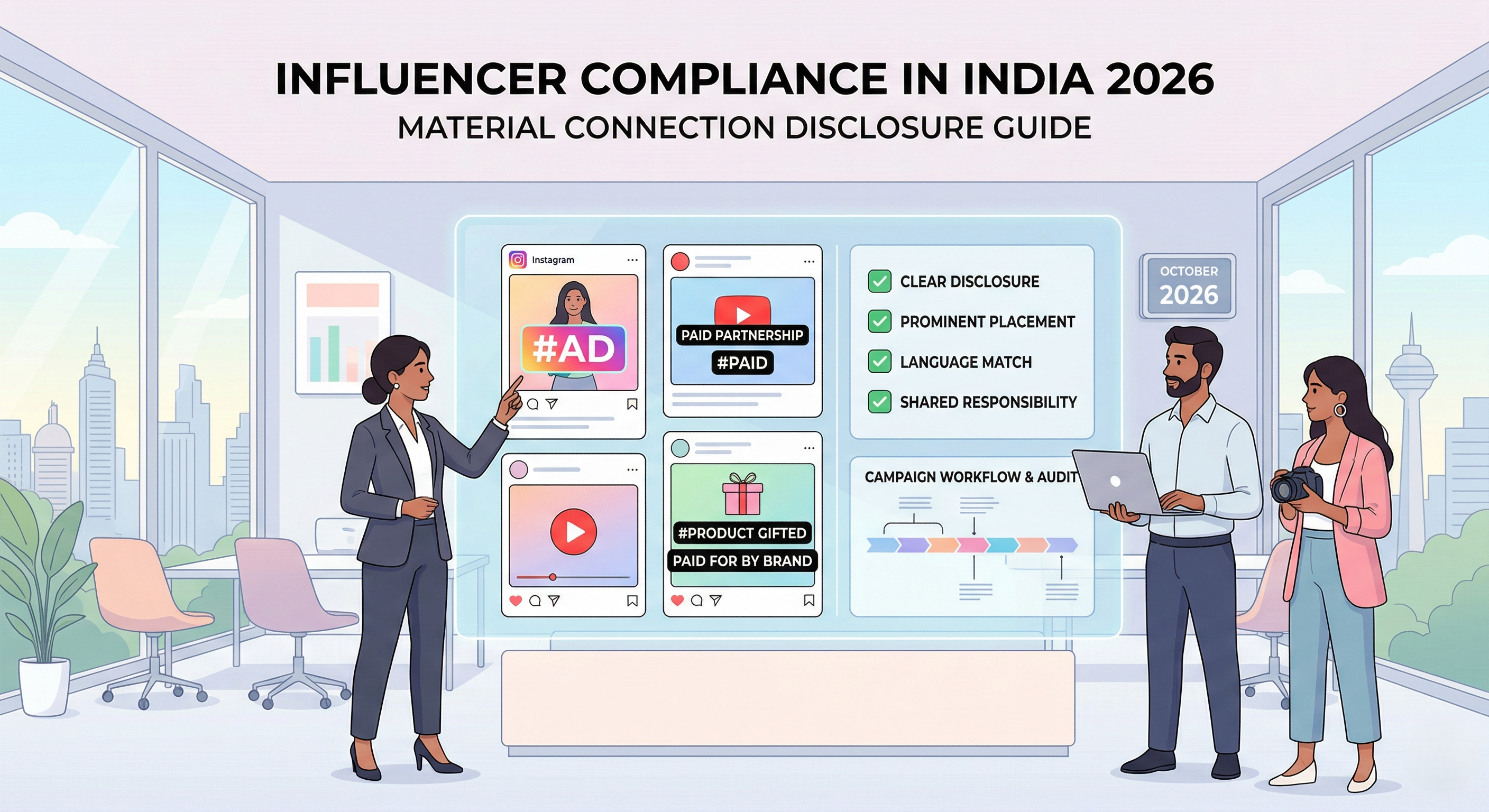
The central obligation under the ASCI influencer disclosure rules India enforces is straightforward: any material connection between a brand and a creator must be clearly and prominently disclosed to the audience.
A material connection includes all of the following:
- Paid collaborations — cash payments for posts, videos, or Stories
- Product gifting — even where no money changed hands
- Barter arrangements — free services, travel, stays, or experiences received in exchange for content
- Family or employment relationships with a brand being promoted
- Equity stakes or ownership interests in a brand
The word “prominently” is non-negotiable. ASCI is explicit that disclosure must be impossible to overlook — not buried in a string of hashtags, not hidden beneath a “show more” fold, not stated only in a language that the majority of the creator’s audience doesn’t understand.
The ASCI-Approved Disclosure Labels for 2026
ASCI prescribes specific disclosure labels. As of 2026, the accepted labels are:
For paid or sponsored content:
- #Ad
- #Sponsored
- #Paid Partnership (where platform tools support this natively)
- A clear verbal statement — “this video is sponsored by [Brand]” — at the beginning of video content
For gifted products where no payment was made:
- #gifted
- #ProductGift
- A clear verbal or on-screen statement — “I received this product for free from [Brand]”
For brand ambassador roles, affiliate arrangements, or equity stakes:
- #BrandAmbassador
- #Affiliate (specifically for commission-based arrangements)
- A direct statement — “I have a financial interest in this brand” — or equivalent
What is explicitly not acceptable:
- #sp — an abbreviation too obscure for general audiences
- #collab — does not communicate a commercial relationship
- #thankyou — frequently misused to obscure gifted product relationships
- Any disclosure placed only below the caption fold, requiring the viewer to tap “more” to see it
- Disclosure in English when the primary content is in a regional language such as Tamil, Telugu, or Kannada
- Disclosures placed at the end of videos, after branded content has already been consumed
Platform-Specific Compliance Requirements
- The native “Paid Partnership” label (branded content tool) is ASCI-compliant and is the recommended standard for feed posts.
- For Stories, the disclosure label must appear at the beginning — not the final frame.
- For Reels, a visible text overlay in the first frame is required in addition to any caption disclosure.
- For carousel posts, disclosure must appear on the first card — not only in the caption.
YouTube
- Verbal disclosure is required at the beginning of the video — explicitly before the second minute mark.
- On-screen text disclosure must accompany the verbal statement.
- YouTube’s built-in “Includes paid promotion” toggle must be enabled, but this alone does not satisfy ASCI requirements. Explicit verbal and on-screen disclosure remains mandatory.
- For YouTube Shorts, a visible text overlay in the opening frames is required.
Twitter / X
- #Ad or #Sponsored must appear within the tweet text itself — not only in replies or thread extensions.
Blogs and Long-Form Written Content
- Disclosure must appear at the top of the content page — before any branded content — not at the end of the article after the reader has already consumed the material.
The Most Common ASCI Violations Indian Brands Must Avoid
Based on ASCI’s publicly available complaint data from 2024–2025, these are the most frequently cited violations in Indian influencer marketing:
1. No disclosure on gifted products. The single most common violation. Brands send PR packages to creators who post about the products with no disclosure at all. Under ASCI rules, gifted products — even without any cash payment — require clear disclosure every time. Both the brand and the creator can be named in a ruling.
2. Disclosure buried within hashtag clusters. A caption ending “#blessed #lifestyle #mumbai #ad #travel #ootd” does not constitute clear disclosure. The #Ad label is visually invisible within an unrelated hashtag string.
3. Verbal disclosure only at the end of videos. ASCI requires disclosure at the beginning of video content. Disclosing at the end — after the viewer has already watched and processed the branded content — is explicitly non-compliant.
4. Non-disclosure by founders, investors, or employees. When a brand’s founder, investor, or employee creates content about the brand without disclosing their relationship, this constitutes a material connection violation. Disclosure applies to all material relationships, not only external paid creators.
5. Disclosures in English when content is in a regional language. If a Telugu-language creator posts content for a brand and includes only #Ad in English, ASCI may consider this insufficient for their primarily Telugu-speaking audience. Disclosure should be made in the same language as the main content — this is especially important for regional language influencer campaigns across Hindi, Tamil, Marathi, Kannada, Bengali, and Punjabi content.
Who Is Responsible — Brand, Agency, or Creator?
ASCI holds all parties in a campaign accountable. This is a point many Indian brands misunderstand.
The brand is responsible for ensuring all content produced as part of a paid campaign is compliant — even if an individual creator failed to disclose. A brand cannot escape liability by claiming the creator “forgot” or that the brief “mentioned” disclosure without specifying how.
The agency managing the campaign shares responsibility for building disclosure requirements into creative briefs, contracts, and content approval processes.
The creator is directly responsible for the content they publish, including all disclosure obligations. ASCI can name and publicly cite individual influencers in violation rulings.
This shared accountability structure means brands cannot outsource compliance to creators. Disclosure verification must be a formal, documented step in every content approval workflow — not an afterthought.
Building ASCI Compliance into Your Campaign Workflow
Step 1: Add disclosure requirements to every creator contract. Every influencer agreement must explicitly state the required disclosure label, where it must appear, in what format, and in which language. Non-compliance should carry a defined contractual consequence — typically a requirement to edit or remove the non-compliant content within 24 hours of notification.
Step 2: Include disclosure specifications in every creative brief. Your brief should include a standalone “Disclosure Requirements” section that specifies: the exact label to use, placement position (first frame of video / first Story frame / first carousel card / top of caption), language requirement, and confirmation that it must be visible without requiring any user action.
Step 3: Verify disclosure as part of content approval. Before approving any content for go-live, the reviewer must complete a disclosure verification checklist:
- Is the disclosure label present?
- Is it the correct ASCI-approved label?
- Is it prominently placed — not buried?
- Is it in the same language as the primary content?
Step 4: Conduct a post-live audit within 48 hours. After content goes live, verify that disclosures remain present and have not been edited out post-publication. Creators occasionally remove labels after posting. If discovered, immediate correction must be required in writing.
Step 5: Maintain documented records. Keep records of all creator agreements, creative briefs with disclosure specifications, approved content versions, and post-live screenshots showing compliance. In the event of an ASCI complaint, documented evidence of compliance processes is your primary defense against a ruling.
What Happens If You Get It Wrong: ASCI’s Enforcement Process
When a complaint is filed — by a consumer, a competitor, or ASCI’s own monitoring team — the process works as follows: ASCI notifies the brand and creator and requests a response. The Consumer Complaints Council reviews the submission. A ruling is typically issued within 30–45 days.
Rulings can require:
- Immediate withdrawal or modification of the non-compliant content
- Public naming of the brand and creator in ASCI’s monthly violation report — with direct reputational impact
- Referral to the Ministry of Consumer Affairs for severe or repeat violations under the Consumer Protection Act
For brands operating at the scale of 20–50 creator partnerships per month, the statistical probability of a compliance gap somewhere in the program is real. Systematic disclosure verification — built into your approval workflow as a documented process — is the only reliable way to manage compliance at scale.
The Business Case: Why Compliance Also Drives Better ROI
There is a positive commercial argument for ASCI compliance beyond avoiding penalties. Disclosed content actually performs better with sophisticated Indian audiences.
Indian consumers — particularly the urban 18–35 demographic that represents the primary target for most D2C brands — have high sensitivity to undisclosed advertising. When they discover content was sponsored without disclosure, the response is consistently negative: toward the creator for lacking integrity, and toward the brand for the deception. That trust damage persists.
Conversely, transparent disclosure combined with a creator who genuinely uses and recommends a product produces a stronger trust signal than undisclosed content ever can. Audiences who know content is sponsored and still engage with it are higher-intent prospects — they’re choosing to pay attention despite knowing it’s an ad. That quality of attention drives real conversions.
Compliance is not just legal protection. In India’s trust-driven consumer culture, it is brand hygiene that directly supports your ROI.