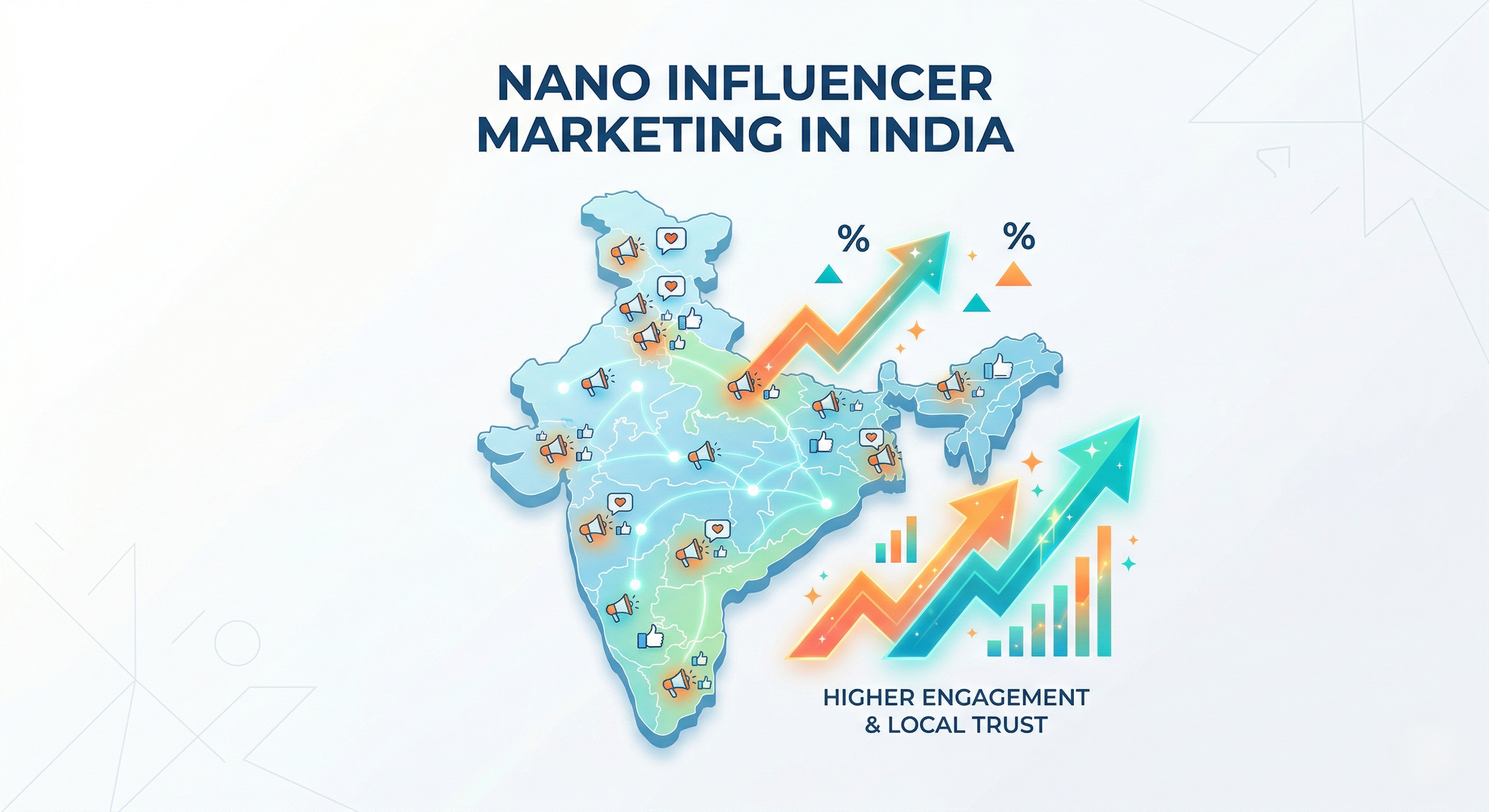
In influencer marketing, bigger has always felt safer. More followers. More reach. More impressive numbers in a campaign report presented to leadership. But for a growing number of Indian D2C brands — particularly those targeting specific regional markets, price-sensitive consumer segments, or tight-knit community groups — the most consistently profitable creator partnerships aren’t with mega-influencers, macro creators, or even micro-influencers.
They are with nano influencers. Creators with 1,000 to 10,000 followers whom most of the marketing industry still dismisses as too small to matter for a serious campaign.
That dismissal is a competitive opportunity for the brands willing to look past the follower count. And in India’s relationship-driven, regionally diverse, trust-first consumer culture, nano influencer marketing works in ways that global strategy frameworks haven’t fully caught up with yet.
What Is a Nano Influencer?
A nano influencer is a content creator with a following typically between 1,000 and 10,000 — though some definitions extend to 20,000. What defines them is not the follower count itself. It is the nature of the relationship between the creator and their audience.
Nano influencers are, in most cases, genuinely embedded in a specific community. They might be a home baker in Coimbatore with 4,000 Instagram followers who posts about recipes and kitchen products. A fitness enthusiast in Jaipur with 6,500 followers documenting a personal fitness transformation. A Punjabi student in Ludhiana with 3,500 followers reviewing affordable fashion finds. A vegetarian food blogger in Ahmedabad with 7,000 followers whose meal ideas her followers cook every week.
Their audiences don’t follow them because of celebrity status or aspirational lifestyle content. They follow them because they feel like they genuinely know this person — and they trust their opinions in ways they simply do not trust creators who have scaled past a certain level of perceived celebrity distance.
The Engagement Reality: Why the Data Consistently Favors Nano
The engagement rate differential between nano and mega influencers in India is not a minor statistical variation. It is a dramatic, consistent, and replicable pattern.
| Creator Tier | Average Engagement Rate (India) |
|---|---|
| Nano (1K–10K) | 7% – 15% |
| Micro (10K–100K) | 3% – 7% |
| Mid-Tier (100K–500K) | 1.5% – 4% |
| Macro (500K–1M) | 0.8% – 2% |
| Mega (1M+) | 0.4% – 1.2% |
A nano influencer’s post routinely drives engagement from 7–15% of their total follower base. A mega influencer’s equivalent post might reach 0.4% of a much larger number. The implication is fundamental: when you’re paying for influence — for the genuine attention of real humans who might act on a brand recommendation — nano influencers are delivering it at rates that no larger tier can match.
The reach is smaller. The quality of that reach is categorically superior.
Why Nano Influencer Marketing Works Especially Well in India
The nano influencer advantage is amplified by specific characteristics of the Indian market that most global strategy frameworks do not adequately account for.
India’s trust ecosystem runs through personal networks. India is a high-context, relationship-first culture. Purchase decisions — particularly for new brands and mid-ticket products — are heavily influenced by the recommendations of people within the buyer’s existing trust circle. A nano influencer who genuinely feels like “one of us” to their audience occupies an exceptionally powerful position in this trust chain. They are not an aspirational figure. They are a peer whose opinion carries the weight of a friend’s recommendation.
Tier-2 and tier-3 city markets are nano influencer territory. India’s fastest-growing consumer markets in 2026 are in cities like Ludhiana, Surat, Nagpur, Coimbatore, Bhopal, Patna, Indore, and Vadodara — where national macro influencers with metropolitan followings have limited cultural resonance and where local voices carry extraordinary credibility. Nano influencers embedded in these cities are often the most trusted local voices in their product category. Their reach within a specific city or community is something no national campaign can replicate at equivalent cost.
Regional language nano creators represent India’s most underpriced creator channel. A Marathi-language nano influencer with 6,000 highly engaged followers in Pune costs a fraction of a Mumbai-based English-speaking macro influencer — but may generate substantially more Pune-based conversions for a regionally relevant product. This pricing gap, combined with the engagement advantage of the nano tier, makes regional language nano influencer marketing one of the clearest ROI opportunities available to Indian D2C brands right now.
Indian Gen Z audiences reject inauthentic commercial content. India’s 18–28 demographic is acutely sensitive to manufactured paid content. They can identify a scripted, overly polished sponsored post from its opening seconds. Nano influencers — who typically do not rely on brand deals as a primary income source and only promote products they genuinely use and believe in — consistently produce content that reads as authentic to this audience. That authenticity gap between nano and large-tier creators is measurable in engagement rates and, more importantly, in conversion rates.
The Cost Advantage: What Nano Budget Unlocks
The economics of nano influencer marketing in India are genuinely transformative for brands with defined budgets or those testing a new market before committing significant spend.
Typical nano influencer rates in the Indian market:
| Content Format | Rate Range |
|---|---|
| Instagram Reel | ₹1,000 – ₹8,000 |
| Instagram Static Post | ₹500 – ₹4,000 |
| Instagram Story (3 frames) | ₹500 – ₹3,000 |
| YouTube Short | ₹2,000 – ₹8,000 |
| Product gifting only (no cash) | ₹0 cash — product cost only |
Many nano influencers — particularly those early in their creator journey or genuinely passionate about a specific product category — will create content in exchange for the product itself, with no cash payment required.
The budget comparison: For the cost of a single mid-tier influencer integration at approximately ₹1,50,000, a brand could activate 30–50 nano influencers through product gifting. Those 30–50 creators collectively reach between 30,000 and 300,000 people — but with engagement rates 3–5x higher than a single mid-tier placement, and with audience trust levels that fundamentally shift conversion probability.
The reach is distributed rather than concentrated. The results are more consistent, more attributable, and more resilient to the underperformance of any single creator.
Nano Influencer Campaign Models That Work in India
Product Seeding Campaigns Send your product to 50–100 nano influencers with no mandatory posting requirement — only a genuine request to share their honest experience if they enjoy it. The content generated is completely authentic because it is voluntary. Disclosure is transparent. And the cumulative reach across dozens of genuine community advocates creates durable brand awareness in the specific communities where your customers live and buy.
This model is particularly effective in food, beauty, home, and lifestyle categories where “someone I follow actually tried this” is a primary purchase trigger — especially in tier-2 cities across Punjab, Maharashtra, Gujarat, and Tamil Nadu.
Simultaneous Launch Amplification For a new product launch, activate 20–40 nano influencers across your target cities simultaneously — all posting within the same 1–2 week window. The cumulative effect creates the impression of widespread organic buzz rather than a single coordinated campaign. When consumers encounter a product recommended by multiple trusted community voices in a short period, it accelerates purchase confidence in ways a single large campaign cannot.
Regional Market Entry Before committing significant budget to a new state or city market, activate 10–20 nano influencers who are embedded in that specific community. Their existing local credibility gives your brand a genuine community foothold at far lower cost and far higher trust than any paid media placement in the same market.
Community-Specific Targeting Nano influencers often have audiences defined by extremely specific shared identity — long-distance runners in Chennai, vegetarian home cooks in Gujarat, UPSC aspirants across Hindi-belt cities, engineering students in Hyderabad, handloom fabric enthusiasts in West Bengal. For products with a clear community fit, a nano creator embedded in that community delivers targeting precision that no media buying platform can match.
How to Find and Manage Nano Influencers at Scale
The primary operational challenge of nano influencer marketing is volume. Managing 50 nano partnerships generates roughly five times the management work of 10 mid-tier partnerships — when done manually.
Discovery Manual discovery through Instagram hashtag searches, particularly for regional language nano creators, is genuinely inefficient at scale. Purpose-built discovery platforms with filters for follower range, engagement rate, niche, location, and content language reduce what used to be a days-long manual process to under an hour. For regional market campaigns specifically, filtering by city and language is essential — national English-language searches systematically miss the best regional nano creators.
Outreach Nano influencers respond best to personal, direct, brief outreach — a genuine DM or short email explaining specifically why you think they’d be a good fit for your product. Copy-pasted campaign templates designed for macro outreach generate low response rates at the nano tier. Personalization — even minimal — significantly improves both response rate and content quality because it signals that the brand is paying real attention.
Content and Campaign Management With 30–50 nano creators active simultaneously, tracking content submissions, approval status, and go-live dates in a spreadsheet becomes unmanageable quickly. A campaign management platform that centralizes content submissions and tracks creator status across an entire campaign — from outreach through approval through post-live — is not a luxury at this volume. It is an operational requirement.
Payment Many nano arrangements involve product gifting only, which eliminates cash payment complexity. For cash arrangements, individual payment amounts are small — typically ₹1,000–₹8,000 per creator — but processing them individually at scale still consumes significant finance team time without automation. Platforms that batch creator disbursements reduce this to a single monthly operation.
Measuring Nano Influencer Campaign ROI
Measuring nano influencer ROI requires a slightly adapted approach compared to mid-tier or macro campaigns, because impact is distributed across many creators rather than concentrated in a few large placements.
Unique Discount Codes per Creator Assign every nano influencer a distinct discount code. Even at 5,000–8,000 followers, a creator whose community genuinely trusts them can drive meaningful code redemptions that are directly attributable. Tracking at the individual creator level identifies your highest-converting nano creators for priority in future campaigns — building an increasingly valuable performance database over time.
UTM-Tagged Links Provide each creator with a unique UTM-tagged link for their bio or Linktree placement. Track clicks and attributed conversions per creator. Even 3–8 purchases per nano creator represents a strong conversion rate relative to their audience size — and is significantly more cost-efficient than equivalent conversions driven through macro placements.
Aggregate Campaign Metrics Report on total aggregate reach across all nano creators, total engagements generated, and total attributed conversions. The engagement-to-reach ratio for a well-executed nano campaign will typically be 3–5x better than a comparable macro campaign — and the cost-per-conversion will be proportionally lower.
Organic Brand Mention Monitoring Nano campaigns frequently generate organic conversation that won’t be captured through codes or tracked links — comments where followers tag friends, Stories where the creator mentions your product unprompted outside the formal campaign window, word-of-mouth recommendations that happen entirely off-platform. Monitor brand mentions across Instagram, YouTube Shorts, and Twitter/X during and after the campaign period to capture the full conversation impact that attribution models undercount.
Building a Long-Term Nano Influencer Network in India
The highest-value nano influencer relationships are not transactional. The brands generating the most sustainable ROI from nano influencer marketing in India are building ongoing networks of 50–200 nano creators who consistently advocate for their brand across specific communities — not because of individual campaign contracts, but because they genuinely use the product and feel part of the brand’s story.
This network, built deliberately over 12–24 months across regional markets including Punjabi-speaking communities in the north, Tamil and Telugu markets in the south, Marathi-speaking audiences in Maharashtra, and Hindi-belt consumers across Uttar Pradesh and Rajasthan, becomes a distribution channel that no competitor can easily replicate. It is embedded in real communities, powered by genuine trust, and grows with every new nano creator who tries the product and wants to share it with their circle.
In a market as large, regionally diverse, and relationship-driven as India, that kind of distributed, authentic community presence is worth more than any single high-reach campaign — and it compounds in value every month it runs.
Ready to build your nano influencer network across India’s regional markets? Opsero’s Discovery engine lets you filter by follower range, engagement rate, location, content language, and niche — so you can find and shortlist 50 nano influencers in your target cities in the time it used to take to find five.