When Indian marketers think about influencer marketing, Instagram usually comes to mind first. It’s visual, fast, and the dominant platform for creator discovery in metropolitan markets. But for brands that want to drive actual purchase decisions — not just awareness impressions — YouTube influencer marketing in India consistently delivers better conversion quality than any other platform.
The reason is intent. India is YouTube’s largest market globally, with over 462 million users as of 2025 — a number that continues to grow fastest in tier-2 and tier-3 cities where video content in regional languages has become the primary mode of digital information consumption. And unlike Instagram’s passive scroll model, YouTube viewers actively search for content with real purpose: tutorials, product reviews, comparisons, unboxing videos. Someone searching “best protein powder India 2026” or “affordable skincare routine under ₹500” is already in a research or buying mindset before a single second of your brand integration plays.
That intent differential is what makes YouTube influencer marketing India’s highest-conversion creator channel — and why brands that invest in it seriously see compounding returns that Instagram campaigns simply cannot match.
Why YouTube Converts Differently Than Instagram in India
The fundamental difference between YouTube and Instagram influencer marketing is not reach. It is the state of mind of the viewer at the moment they encounter your brand.
Instagram users discover branded content while passively scrolling their feed or Explore page. The content interrupts their session. Even the best-performing Instagram Reel needs to capture attention in the first 2–3 seconds before the viewer reflexively scrolls past. The purchase intent behind that attention is low.
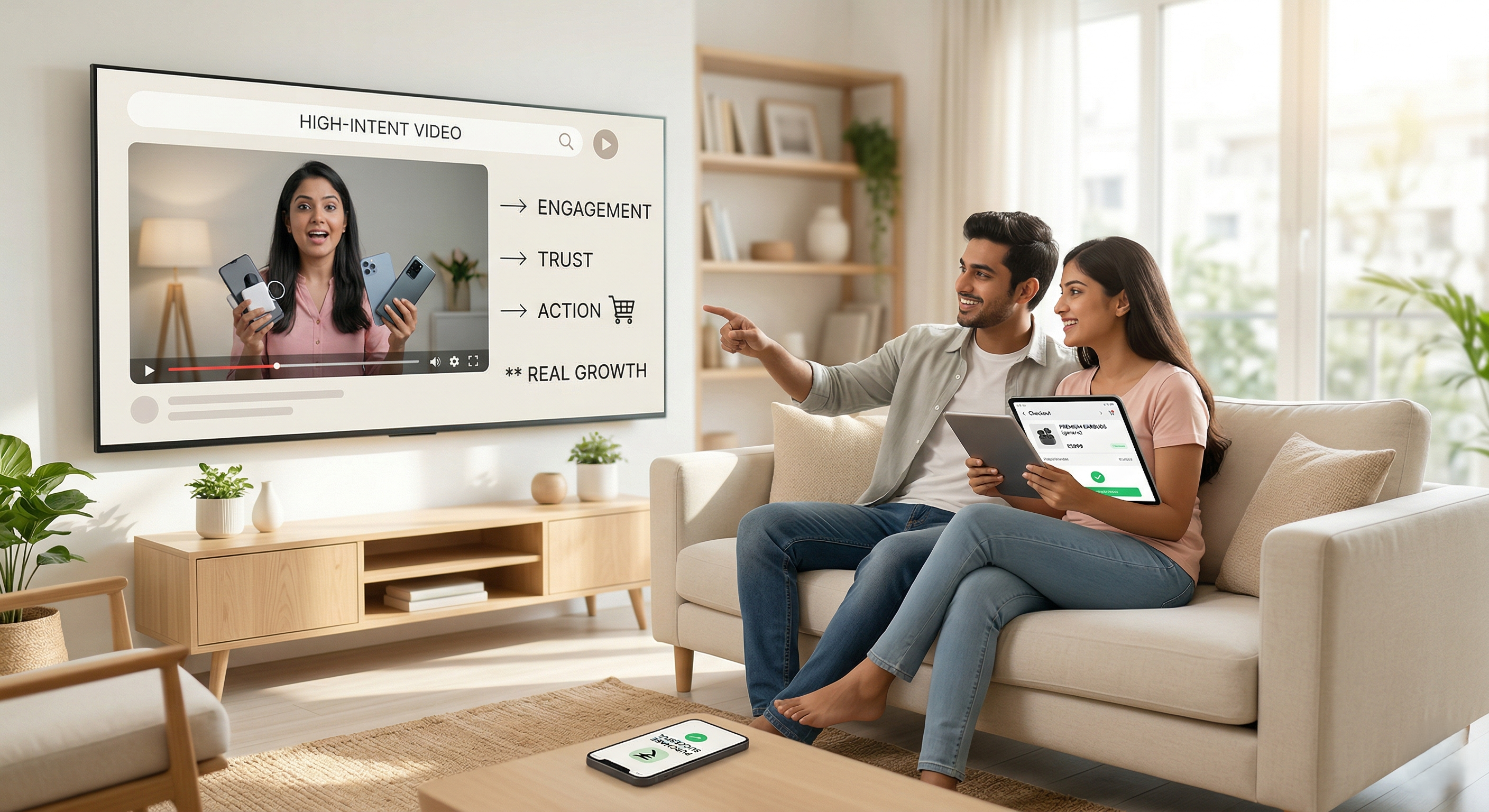
YouTube users, by contrast, actively choose to watch specific content. They typed a search query. They selected a video from the results. They’re watching it because it directly addresses something they want to know or decide. When a YouTuber they trust reviews your product within that context — a context the viewer themselves created — the recommendation carries a completely different weight than a Reel that appeared unsolicited in a feed.
This intent difference explains a consistent pattern across Indian D2C brands: YouTube influencer brand integrations drive higher-quality website traffic, longer on-site session durations, lower bounce rates, and better conversion rates than equivalent Instagram placements — even when the raw reach numbers are significantly smaller.
YouTube Content Formats for Brand Integration: What to Request and What to Pay For
Understanding which content format fits your objective — and what each format realistically costs — is essential before approaching any Indian YouTuber for a brand deal.
Dedicated Review or Sponsored Video The entire video focuses on your product or brand. Maximum messaging space, deepest product explanation, strongest brand signal. Also the most expensive format and the most obviously commercial, which can reduce authenticity if the creator isn’t a genuine product user.
Best for: New product launches, category entry for a product that needs demonstration, high-consideration categories like electronics, skincare, fitness equipment.
Mid-Roll Brand Integration Your brand is woven into 60–120 seconds within a longer video that is not primarily about your product. The creator speaks about your brand naturally as part of their regular content flow. This format feels considerably less commercial and often generates stronger trust metrics than dedicated videos.
Best for: Awareness within a highly engaged niche audience, brand association with an established creator community, categories where seamless integration serves authenticity.
Intro or Outro Mention A brief 20–30 second brand mention at the beginning or end of a video. Lowest cost, lowest messaging depth, but useful for reach building and brand frequency across multiple placements.
Best for: Budget-efficient frequency building, running alongside deeper integration placements as part of a larger YouTube strategy.
YouTube Shorts Integration Vertical, 60-second-or-under format, Shorts feed distribution. Growing rapidly across India’s tier-2 and tier-3 markets. Significantly lower cost than long-form integrations, but limited depth for product messaging.
Best for: Supplementing long-form campaigns, reaching younger audiences in smaller cities, regional language content at scale.
Tutorial or How-To Video The creator builds content around a use case that naturally features your product — a makeup tutorial featuring your foundation, a cooking video using your appliance, a tech setup video featuring your device. High authenticity, strong conversion signals, particularly useful for products where purchase hesitation is driven by uncertainty about how to use the product.
Best for: Products that benefit from demonstration; categories where showing “how to use” directly builds purchase confidence.
Finding the Right YouTubers in India: What Actually Matters
YouTube’s creator landscape in India is structured differently from Instagram, and the selection criteria that matter are not the same.
Subscriber count is a starting point — average views per video is the real metric. On YouTube, the ratio of views to subscribers reveals far more than subscriber count alone. A channel with 600,000 subscribers averaging 70,000 views per video is delivering better real reach than a channel with 2 million subscribers averaging 25,000 views. Always examine average view count across the last 10–15 videos before any outreach.
Niche-specific channels consistently outperform general lifestyle channels for conversion. A dedicated personal finance channel with 200,000 subscribers will convert financial product interest far more reliably than a general lifestyle vlogger with 3 million subscribers whose audience watches for personality. Specificity of niche correlates directly with specificity of audience intent.
Regional language YouTube is India’s most undervalued creator channel. Tamil, Telugu, Kannada, Marathi, and Punjabi YouTube channels routinely outperform English-language equivalents in regional conversion metrics. For products with regional demand, a ₹1.5 lakh integration with a respected Tamil tech reviewer may generate more qualified conversions in Tamil Nadu than a ₹6 lakh integration with a national English-language creator whose audience is geographically diffuse. Regional language YouTube influencer marketing in India represents one of the clearest ROI opportunities available to brands willing to build a regional-first strategy.
Comment quality is a stronger trust signal than comment quantity. YouTube comments are one of the most reliable indicators of a creator’s genuine influence. Are viewers asking substantive questions about reviewed products? Are they tagging friends with buying intent? Are there follow-up comments confirming actual purchases based on the creator’s recommendation? This level of comment activity signals a creator who genuinely moves purchasing decisions — not just one who attracts passive viewers.
YouTube Influencer Pricing in India: 2025 Benchmarks
Pricing varies significantly by channel size, niche, content format, and exclusivity terms. These are realistic market benchmarks for India:
| Channel Size | Avg. Views / Video | Dedicated Video | Mid-Roll Integration | YouTube Shorts |
|---|---|---|---|---|
| Nano (10K–50K subs) | 5K – 20K | ₹10,000 – ₹40,000 | ₹5,000 – ₹20,000 | ₹3,000 – ₹10,000 |
| Micro (50K–300K subs) | 20K – 80K | ₹40,000 – ₹2,00,000 | ₹20,000 – ₹80,000 | ₹10,000 – ₹40,000 |
| Mid-Tier (300K–1M subs) | 80K – 3,00,000 | ₹2,00,000 – ₹8,00,000 | ₹80,000 – ₹3,00,000 | ₹40,000 – ₹1,50,000 |
| Macro (1M–5M subs) | 3,00,000 – 15,00,000 | ₹8,00,000 – ₹30,00,000 | ₹3,00,000 – ₹10,00,000 | ₹1,50,000 – ₹5,00,000 |
Factors that adjust rates above these benchmarks:
- Niche premium: Finance, health, and tech creators command 20–40% higher rates than general lifestyle channels of equivalent size.
- Category exclusivity: No competitor promotions for 30–90 days typically adds 20–40% to base rates.
- Usage rights: Repurposing the video as a paid advertisement requires separate negotiation — typically adding 30–50% to the base integration fee.
- Script approval: Creators who allow full brand-provided scripts may charge more to compensate for reduced creative autonomy; conversely, brands requesting loose integration briefs may negotiate lower rates.
Tracking YouTube Influencer ROI: The Metrics That Matter
YouTube integrations require a measurement approach specifically adapted to the platform’s unique content lifecycle and audience behavior.
Average View Duration, Not Just Total Views A 12-minute review video where viewers watch an average of 8 minutes delivers dramatically more brand exposure than one with the same total views but 15% average view duration. Request watch time data — specifically average view duration — as part of your campaign performance reporting.
Click-Through Rate on In-Video Links YouTube cards, end screen elements, and description links are your primary CTA mechanism. Track clicks on these separately from all other traffic sources. Realistic CTR benchmarks for well-placed YouTube links in the Indian market: 0.5%–2.5% of total views depending on niche and CTA strength.
UTM-Tagged Links and Unique Discount Codes Give every YouTuber a unique UTM-tagged link and a unique discount code. Description box links and pinned first comments are the primary click driver — verify these are correctly set up before the video publishes, not after.
Long-Tail Attribution — The YouTube Advantage This is where YouTube fundamentally separates itself from Instagram as an influencer channel. A YouTube review video lives indefinitely and continues surfacing in search results months and years after publication. Track your UTM and discount code performance at 30, 60, 90, and 180 days post-publication. For evergreen product categories — skincare, fitness, home products, personal finance tools — a significant share of total attributed conversions will arrive 2–4 months after the original go-live date.
Brands that only measure YouTube ROI in the first week post-publication systematically undervalue the channel by 30–60%.
Branded Search Volume Uplift After a significant YouTube campaign with multiple placements, monitor your brand name search volume through Google Search Console. A well-placed integration from a trusted creator consistently drives measurable uplift in branded search queries — a high-intent conversion signal that UTM data won’t capture but represents genuine campaign value.
Step-by-Step YouTube Influencer Campaign Framework
Phase 1: Discovery and Vetting Identify 15–20 candidate channels using subscriber count, average views per video, niche alignment, and audience demographics. Shortlist to 5–8 based on view-to-subscriber ratio, comment quality, and review of past brand integrations. Confirm no recent competitor promotions. For regional campaigns, prioritize regional language channels as the primary discovery pool.
Phase 2: Outreach and Contract Approach shortlisted creators with a specific integration format, timeline, and budget range. Negotiate usage rights, exclusivity requirements, and approval process terms upfront. Include ASCI disclosure requirements — verbal at the beginning of video, on-screen text, YouTube’s paid promotion toggle enabled — as contractual obligations with defined correction timelines for non-compliance.
Phase 3: Briefing Provide a brief that covers: brand story context (2–3 paragraphs), key product points to address (maximum 3–4 points), what not to claim or say, the CTA format and placement, and disclosure requirements. Do not provide a full script. A creator’s authentic voice and natural delivery is the primary reason their audience trusts their recommendations. Scripting it away removes the core value of the integration.
Phase 4: Content Review and Approval Review the submitted video for: accuracy of all product claims, correct UTM link and discount code setup in the description, ASCI-compliant disclosure placement (verbal in opening minute, on-screen text, toggle enabled), and brand alignment. Provide one consolidated round of specific, written feedback if required. Approve final cut.
Phase 5: Live Tracking and Long-Tail Measurement Verify all description links and codes are correctly live before the video publishes. Set tracking checkpoints at Day 7, Day 30, Day 90, and Day 180. Compare cumulative performance against pre-campaign traffic and sales baselines. Build running channel-level performance data across multiple campaigns to identify your highest-converting YouTube creators for ongoing partnership.
Why YouTube Builds Compounding Value That Instagram Cannot
Unlike Instagram Stories that disappear in 24 hours or Reels with a 2–4 week peak engagement window, YouTube videos compound in value over their entire published lifetime. A high-quality integration with a credible Indian creator in a relevant niche can continue driving discovery and attributed conversions 2–3 years after the original publication — particularly for products featured in “best of 2025,” “top picks,” or comparison-style videos that rank durably in Google search results.
This compounding characteristic is why brands that commit to YouTube as a serious influencer channel see cost-per-acquisition from the channel improve year-over-year even without increasing spend — as older integrations continue generating traffic alongside new placements.
The upfront investment per placement is higher than Instagram. The long-term return, measured over the actual lifetime of the content, is unmatched by any other influencer marketing channel in India.