Content approvals are the silent timeline killer in influencer marketing.
You brief a creator 2 weeks before the go-live date. They submit content 3 days before posting. It gets forwarded into a group WhatsApp, where the brand manager says “looks great!” but then someone from the legal team has a concern, and then the marketing director wants a different angle, and suddenly you’re asking a creator to post live content at 11pm on a deadline because the internal review process absorbed the entire buffer.
Every influencer marketing team has this story. Most have it multiple times per quarter. Here’s how to fix it permanently.
Why Approval Processes Break Down
Most content approval failures trace to a single root cause: no defined process exists.
Without a defined process, feedback arrives from 5 different people through 4 different channels. It’s unclear whose feedback is binding versus optional. Nobody knows the current approval status of any content at a given moment. Verbal revisions leave no written record. Creators are left in limbo, unable to plan their scheduling. And deadline buffers that should protect go-live dates are eroded entirely.
The fix isn’t more headcount. It’s a documented process that runs consistently every time.
The 5 Principles of a High-Functioning Content Approval Workflow
Principle 1: One Channel for All Content Submission
Creators should submit all content — drafts, revisions, final cuts — in a single, centralized platform. Not via email. Not via WhatsApp. Not via Google Drive links. One place, every time. This eliminates version confusion, prevents lost submissions, and creates a complete content record linked to the campaign.
Principle 2: Designated Reviewers with Defined Roles
For every campaign, designate clearly: a primary reviewer responsible for feedback within 24 hours, a final approver whose sign-off makes content go-live, and optional secondary reviewers for legal or compliance categories. Everyone else is excluded from the review loop by design.
Principle 3: Specific, Written Feedback Every Time
Vague feedback wastes everyone’s time and generates poor revisions. Useful feedback is specific, references a timestamp or element, and tells the creator exactly what to change without dictating their creative voice.
| Vague — Avoid | Specific — Use |
|---|---|
| ”The vibe is off." | "The opening 5 seconds feel too scripted. Re-film in a casual, natural setting." |
| "Mention the code more." | "Add the discount code verbally at 0:22–0:25 and as a text overlay at the end." |
| "This doesn’t feel authentic." | "The product hold at 0:10 looks staged. Show it in actual use rather than held toward camera.” |
Principle 4: Clear Turnaround SLAs
A standard 24-hour primary review window and 48-hour total approval cycle is achievable for most teams and gives creators predictable scheduling certainty. When turnaround times are undefined, timelines collapse by default.
Principle 5: Version Tracking and Approval Records
Every submitted piece of content — original draft, feedback given, revised version, final approved status — should be logged in your campaign record. This serves as dispute resolution if there’s ever a question about what was approved, a compliance audit trail for regulated categories, and revision pattern data to improve future briefs.
The Lean Approval Workflow: 4 Stages, 3–5 Days Total
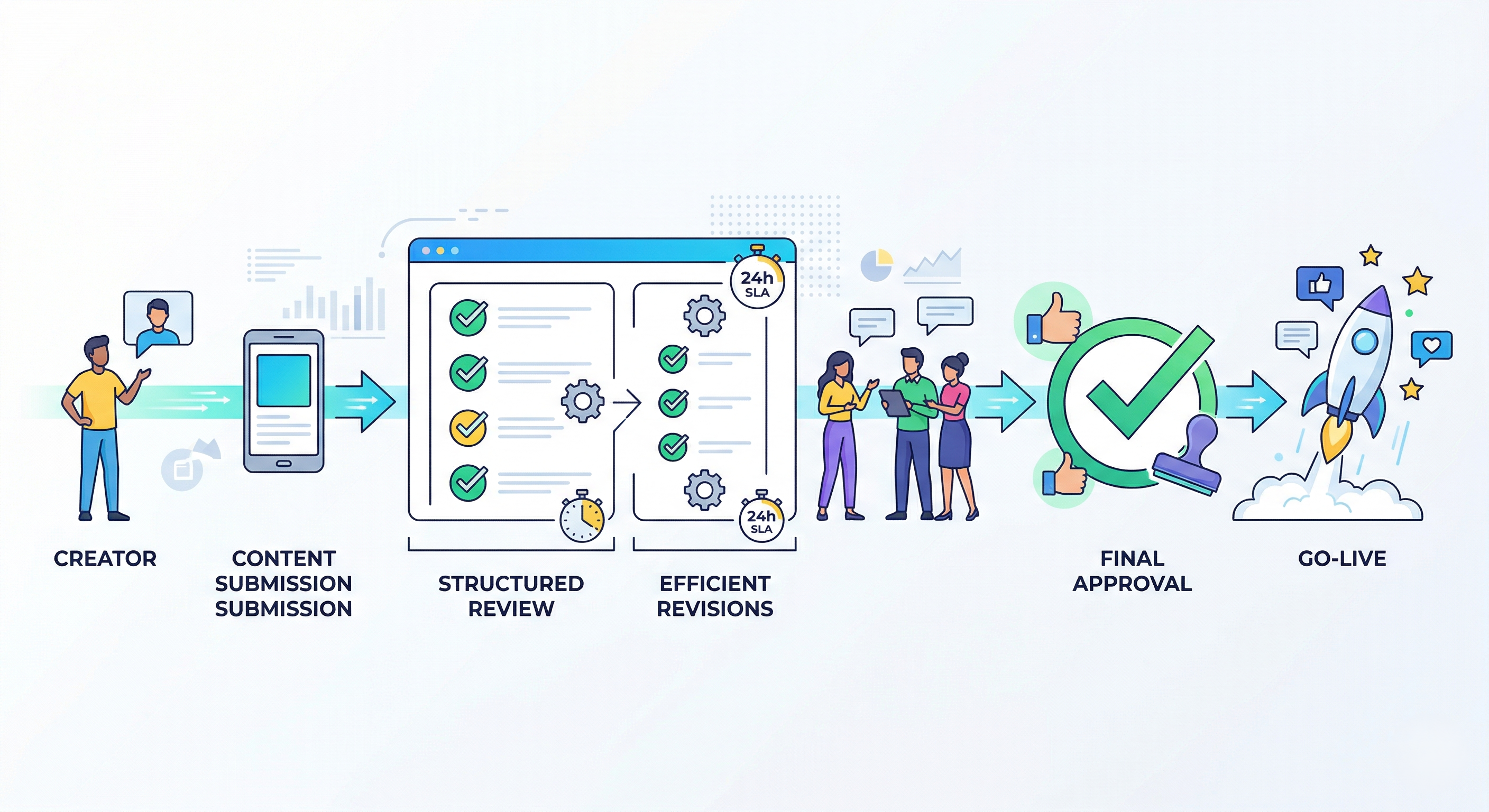
Stage 1 — Creator Submits Draft Creator uploads content directly in the campaign platform. Campaign status updates to “In Review.” Primary reviewer is notified automatically.
Stage 2 — Primary Review (24h SLA) Brand manager reviews and either approves and routes to the final approver, or provides one clear, written round of structured feedback. Maximum one consolidated feedback round from the brand side before resubmission.
Stage 3 — Creator Revision (24h SLA) Creator addresses feedback and resubmits. If feedback was specific and clear, one revision round resolves most issues.
Stage 4 — Final Approval Final approver signs off. Campaign status changes to “Approved.” Creator is notified and can schedule their post. Post-live tracking begins.
Total elapsed time: 3–5 days, compared to unstructured approvals that routinely consume 10–14 days and push posts past campaign windows.
When to Use Concept Review vs. Final Review
Hard approval — always required: Final content before going live. Non-negotiable.
Concept or storyboard review — optional: Useful for high-production campaigns like YouTube integrations or brand films, where approving direction before filming saves costly reshoots. For standard Reels, Stories, and short-form content, skip concept reviews. They add time without proportionate value. Trust the brief. Trust the creator. Save your review cycles for the final cut.
The Compounding Return of Getting This Right
Brands that implement clean, consistent content approval workflows consistently report fewer last-minute posts, fewer revision rounds, better creator relationships, more content available for paid amplification, and shorter overall campaign cycles.
The approval stage looks like a minor operational detail. When it breaks down across 20 campaigns per quarter, it becomes a major performance drag. Fix it once, with a documented process, and it runs consistently without management overhead.
Ready to run influencer campaigns that move from discovery to live post without the chaos? Opsero gives your team one platform to find the right creators, manage campaigns end-to-end, approve content with structure, and process payments automatically — built for Indian brands and agencies who want results, not admin work.